
- Home
Edition
Africa Australia Brasil Canada Canada (français) España Europe France Global Indonesia New Zealand United Kingdom United States Skip to content Edition:
Global
Edition:
Global
- Africa
- Australia
- Brasil
- Canada
- Canada (français)
- España
- Europe
- France
- Indonesia
- New Zealand
- United Kingdom
- United States
Academic rigour, journalistic flair
 Canadian troops walk on the tarmac after disembarking from a military transport plane at Kabul international airport in Kabul, Afghanistan, in July 2003.
(AP Photo/Apichart Weerawong)
Hey Trump: Here’s how Canada punched above its military weight in Afghanistan — from someone with a front-row seat
Published: February 3, 2026 6.46pm GMT
Eugene Lang, Queen's University, Ontario
Canadian troops walk on the tarmac after disembarking from a military transport plane at Kabul international airport in Kabul, Afghanistan, in July 2003.
(AP Photo/Apichart Weerawong)
Hey Trump: Here’s how Canada punched above its military weight in Afghanistan — from someone with a front-row seat
Published: February 3, 2026 6.46pm GMT
Eugene Lang, Queen's University, Ontario
Author
-
 Eugene Lang
Interim Director, School of Policy Studies, Queen's University, Ontario
Disclosure statement
Eugene Lang is affiliated with Canadian Association of Defence and Security Industries
Partners

Queen's University, Ontario provides funding as a founding partner of The Conversation CA.
Queen's University, Ontario provides funding as a member of The Conversation CA-FR.
View all partners
DOI
https://doi.org/10.64628/AAM.pudvqq9n7
https://theconversation.com/hey-trump-heres-how-canada-punched-above-its-military-weight-in-afghanistan-from-someone-with-a-front-row-seat-274901 https://theconversation.com/hey-trump-heres-how-canada-punched-above-its-military-weight-in-afghanistan-from-someone-with-a-front-row-seat-274901 Link copied Share articleShare article
Copy link Email Bluesky Facebook WhatsApp Messenger LinkedIn X (Twitter)Print article
“We’ve never needed them. We have never really asked anything of them. You know, they’ll say they sent some troops to Afghanistan, or this or that. And they did — they stayed a little back, a little off the front lines.” So said United States President Donald Trump recently, referring to America’s NATO allies, including Canada.
The comments have provoked outrage. British Prime Minister Keir Starmer called them “frankly appalling,” especially the insinuation that soldiers from other NATO states avoided the front lines in Afghanistan, leaving the most dangerous heavy lifting to American forces.
Anyone moderately familiar with NATO’s involvement in Afghanistan knows Trump’s insult is rubbish — especially when it comes to Canada.
The Canadian Armed Forces were deployed in some of the most dangerous regions and complex situations in Afghanistan for more than a decade, paying a heavy price in casualties — the heaviest since the Korean War in the early 1950s, when Canada also supported the American-led war effort and more than 500 Canadians died doing so.
What is less commented upon is Trump’s claim: “We’ve never needed them. We have never really asked anything of them.” This, too, is rubbish as far as Canada is concerned.
A front-row seat to Rumsfeld’s request
Twenty-three years ago, in fact, the U.S. asked Canada for something substantive and specific in Afghanistan. And Canada delivered substantively.
The ask came from U.S. President George W. Bush’s secretary of defense, the late Donald Rumsfeld, in January 2003. Famous for being sharp and precise with language, Rumsfeld invited Canada’s defence minister at the time, the late John McCallum, to the Pentagon to make a request.
I was in the room that day, and I heard the ask from Rumsfeld’s own lips (I later wrote about this historic meeting in The Unexpected War: Canada in Kandahar in 2007 and again in 2025 in Chretien and the World: Canadian Foreign Policy from 1993-2003.
Rumsfeld asked Canada to lead the International Security Assistance Force (ISAF), a multi-national stabilization mission then confined to Kabul, the war-torn capital city of Afghanistan. Rumsfeld’s request was an extremely significant one for Canada to digest. It meant providing the largest contingent of troops — about 2,200 — as well as a brigade headquarters and command of the operation.
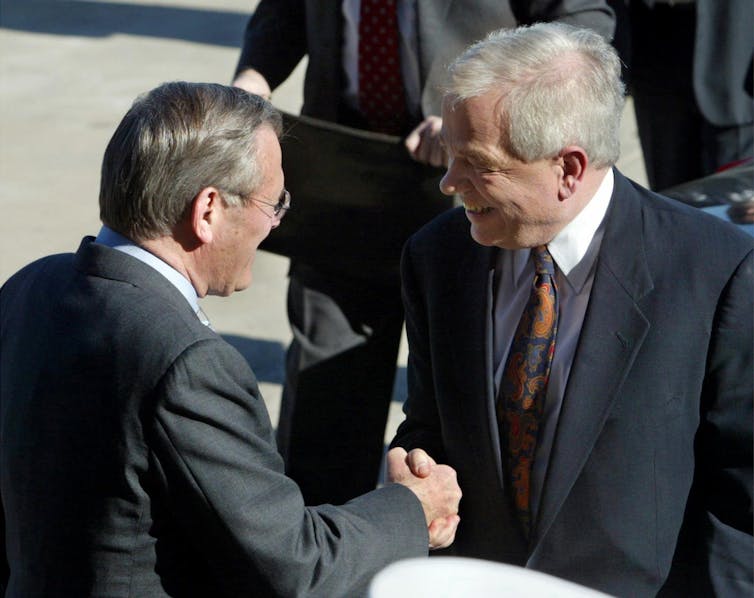 Defense Secretary Donald Rumsfeld, left, greets Canadian Defence Minister John McCallum prior to their meeting at the Pentagon in January 2003.
(AP Photo/Rick Bowmer)
Defense Secretary Donald Rumsfeld, left, greets Canadian Defence Minister John McCallum prior to their meeting at the Pentagon in January 2003.
(AP Photo/Rick Bowmer)
Rumsfeld emphasized how critical the leadership of that mission was from his perspective, and how in his view Canada was better suited to take on the role than any other American ally. Gen. Richard Meyers, chairman of the U.S. Joint Chiefs of Staff at the time, was also present at the meeting and reinforced Rumsfeld’s point that ISAF was key to the Kabul region and Canada was the preferred nation to lead it.
American forces, the defense secretary argued, needed Canada to stabilize Kabul, which was awash in war lords and militia and had no real functioning government at that point.
American forces, meantime, would be otherwise engaged in the invasion of Iraq (which began a few weeks later) and holding the line in southern Afghanistan, where U.S. troops were concentrated.
The Canadian military was needed to hold Kabul together and pave the way for scheduled Afghan elections in 2004, Rumsfeld said. Kabul was an extremely important and vulnerable flank in the American war effort, and Rumsfeld needed Canada to cover that flank.
Canada answered the call
The U.S. needed Canada. The American military needed the Canadian Armed Forces. So Rumsfeld asked Canada for help. Following that meeting, McCallum returned to Ottawa and dutifully presented Rumsfeld’s ask to then Foreign Minister Bill Graham, Prime Minister Jean Chretien, Canada’s military leadership and ultimately the federal cabinet.
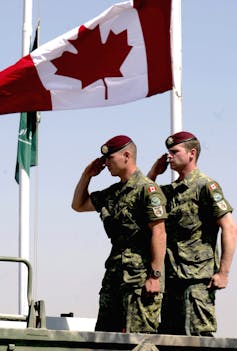 Canadian soldiers salute over the coffins of their fallen colleagues as the coffins are taken to the airport for repatriation to Canada, at Camp Julien in Kabul, Afghanistan in October 2003.
(AP Photo/Richard Vogel)
Canadian soldiers salute over the coffins of their fallen colleagues as the coffins are taken to the airport for repatriation to Canada, at Camp Julien in Kabul, Afghanistan in October 2003.
(AP Photo/Richard Vogel)
It was not an easy ask for Canada to fulfil in terms of military capability, capacity and risk. Canada had never done anything like this before. It was, therefore, not an easy decision to make for the government of Canada and for the Canadian military to deliver.
But Canada answered the call from its closest ally, giving the U.S. exactly what it asked for and what it needed from Canada. And for the next couple of years, more than 2,000 Canadian Armed Forces soldiers were deployed into the dangers and instability of Kabul in what was known as Operation Athena Phase 1 Kabul, where they acquitted themselves exceptionally well — as Rumsfeld predicted they would. Three Canadian soldiers gave their lives during this phase from 2003 to 2005.
Trump needs to be briefed on Canada’s military heroism before he opens his mouth again on this file. And Americans should understand that in the case of Afghanistan, they needed Canada’s help, their government asked Canada for help — and Canada delivered.
- ISAF
- Donald Rumsfeld
- Canadian military
- War in Afghanistan
Events
Jobs
-
 Director of Professional Development
-
Research Fellow in Cybersecurity for Cyber-physical systems
-
University Librarian
-
Video Commissioning Editor
-
Postdoctoral Research Fellow or Research Fellow
 Director of Professional Development
 Research Fellow in Cybersecurity for Cyber-physical systems
 University Librarian
 Video Commissioning Editor
 Postdoctoral Research Fellow or Research Fellow
- Editorial Policies
- Community standards
- Republishing guidelines
- Analytics
- Our feeds
- Get newsletter
- Who we are
- Our charter
- Our team
- Partners and funders
- Resource for media
- Contact us
-
-
-
-
Copyright © 2010–2026, The Conversation