 U.S. Navy/Wikimedia Commons
Deciphering hull markings on Naval ships can be a challenge. From the use of single letters ranging from "A" to "Y," to double and even triple letters, and yes, numbers, there's a veritable smorgasbord of hull indicators that designate the ship's type.
On October 13, 1775, the Continental Congress established the Continental Navy, which at the time had only two ships. After President George Washington established the Naval Act of 1794, the department changed to the U.S. Navy. With only a type and a name given (for example, "the frigate Constitution"), ship names quickly became confusing and repetitive. For example, there had already been five ships named Enterprise by 1874. So, in the 1890s, the Navy began issuing distinctive numbers to address the problem.
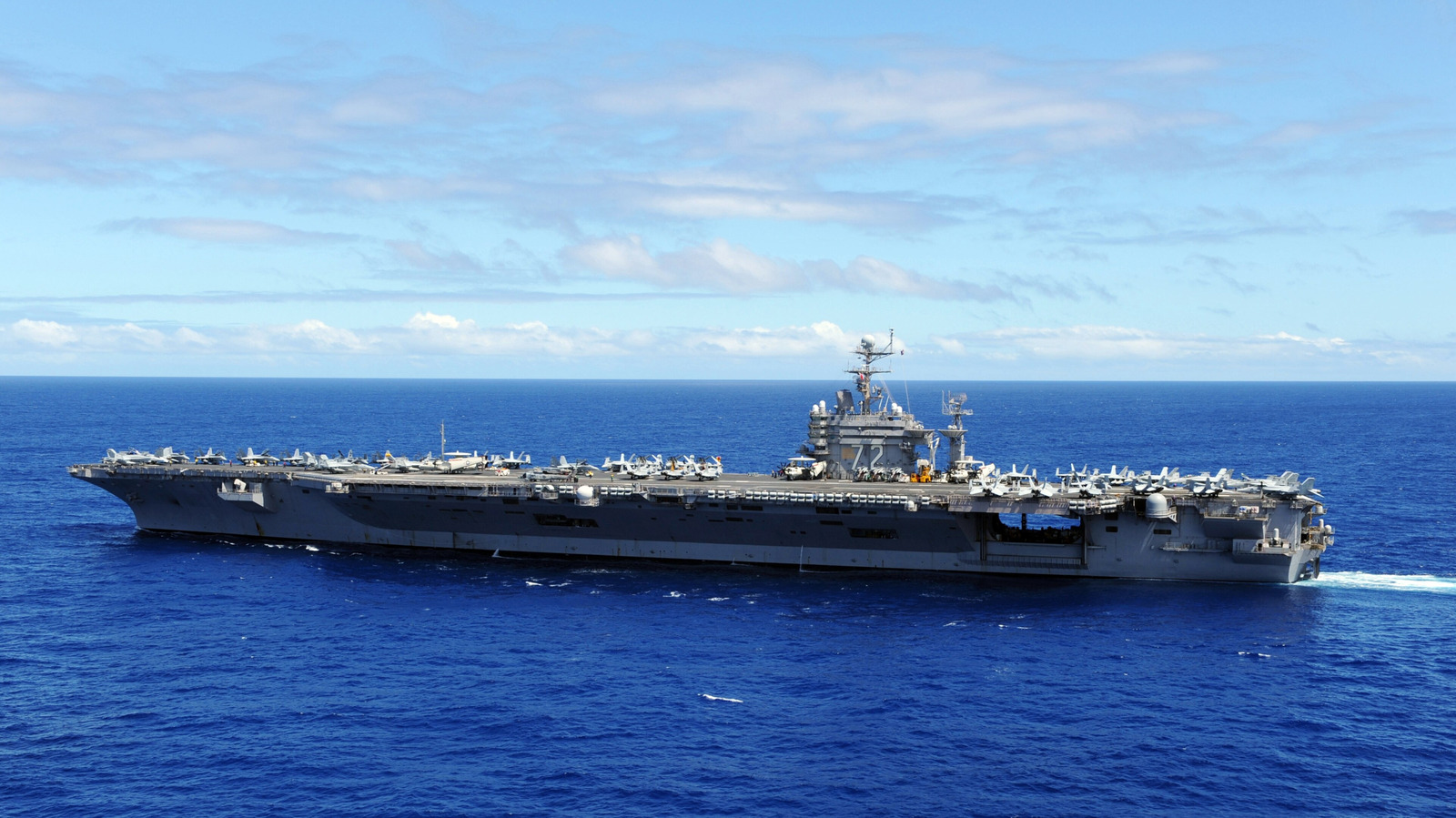
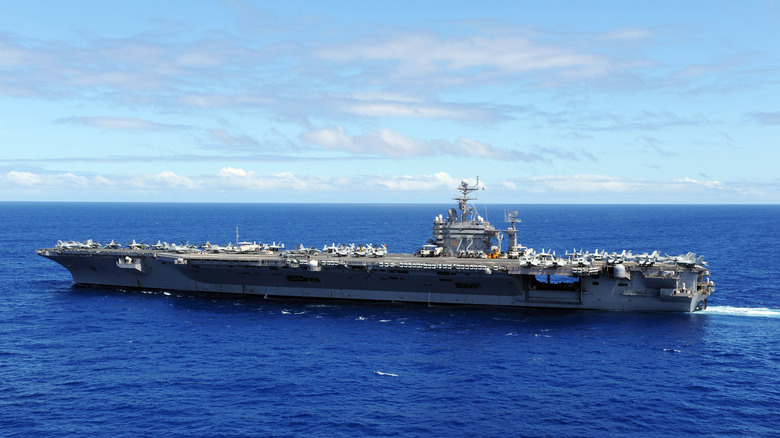
The letters designate the type of craft, of which there are many. "A" stands for "Auxiliary Ship," and "Y" is a "Yard Craft," but the list is extensive and can be very confusing. Thankfully, the numbers are a bit easier to figure out. In this case, the number "72" is the hull number designation for the USS Abraham Lincoln. Technically, its designation is CVN-72, with "CVN" indicating that it's a nuclear-powered aircraft carrier. The USS Abraham Lincoln is the fifth Nimitz-class carrier in the U.S. fleet, which is one of the oldest classes of aircraft carriers still in service. Commissioned in 1989, it's obviously named after our nation's 16th president and is the second ship to hold the name.
The USS Abraham Lincoln bears the number 72
 U.S. Navy/Wikimedia Commons
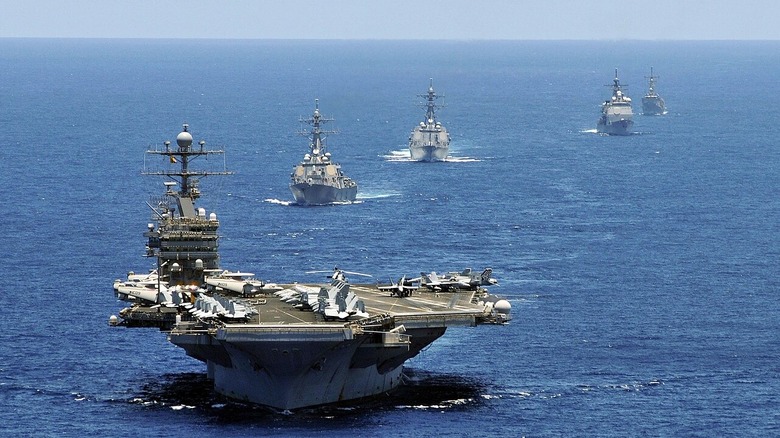
Built by Northrop Grumman Shipbuilding, the USS Abraham Lincoln is approximately 1,000 feet long with a beam of around 250 feet and a displacement of some 97,000 tons. It cruises at speeds over 30 knots, all while carrying roughly 5,000 sailors and nearly 90 aircraft. In April 2021, it completed a planned incremental availability (PIA), which is basically a ship-wide tune-up. During this regularly scheduled maintenance period – usually lasting about six months — ships are brought in for repairs and system upgrades that would be impossible while they're deployed at sea.
Lincoln's 6-month PIA was conducted by Puget Sound Naval Shipyard & Intermediate Maintenance Facility's (PSNS & IMF) San Diego Detachment. It required over 2.6 million hours, equaling 230,000 days of work, at a cost of about $160 million. Included were extensive renovations to the living quarters, laundry spaces, and refrigeration. Structural integrity was improved, and updates to combat systems included modifications that allowed it to accommodate F-35 fighter jets.
Ships usually keep their originally assigned hull number, although they have often been renamed in the past. Still, ships have received new hull numbers due to physical changes to the vessel or ship types being redefined. For instance, in 1928, the USS Chicago (Armored Cruiser 14) was renamed USS Alton and redesignated as IX 5, a miscellaneous auxiliary ship. In 1942, the USS Amsterdam (CL 59), a Cleveland-class light cruiser, was re-ordered as a light aircraft carrier and became the USS Independence (CVL 22). And in 1963, the escort carrier USS Gilbert Islands (CVE 107) was renamed Annapolis (AGMR 1) after it was converted to a major communications relay ship.