
- Home
Edition
Africa Australia Brasil Canada Canada (français) Català España Europe France Global Indonesia New Zealand United Kingdom United States Skip to content Edition:
Global
Edition:
Global
- Africa
- Australia
- Brasil
- Canada
- Canada (français)
- Català
- España
- Europe
- France
- Indonesia
- New Zealand
- United Kingdom
- United States
Academic rigour, journalistic flair
Undertone: this creepy sound horror is utterly terrifying
Published: April 10, 2026 11.28am BST
 Nina Kiri as podcaster Evy in Undertone.
Vertigo Releasing UK
https://theconversation.com/undertone-this-creepy-sound-horror-is-utterly-terrifying-279915
https://theconversation.com/undertone-this-creepy-sound-horror-is-utterly-terrifying-279915
Link copied
Share article
Nina Kiri as podcaster Evy in Undertone.
Vertigo Releasing UK
https://theconversation.com/undertone-this-creepy-sound-horror-is-utterly-terrifying-279915
https://theconversation.com/undertone-this-creepy-sound-horror-is-utterly-terrifying-279915
Link copied
Share article
Share article
Copy link Email Bluesky Facebook WhatsApp Messenger LinkedIn X (Twitter)Print article
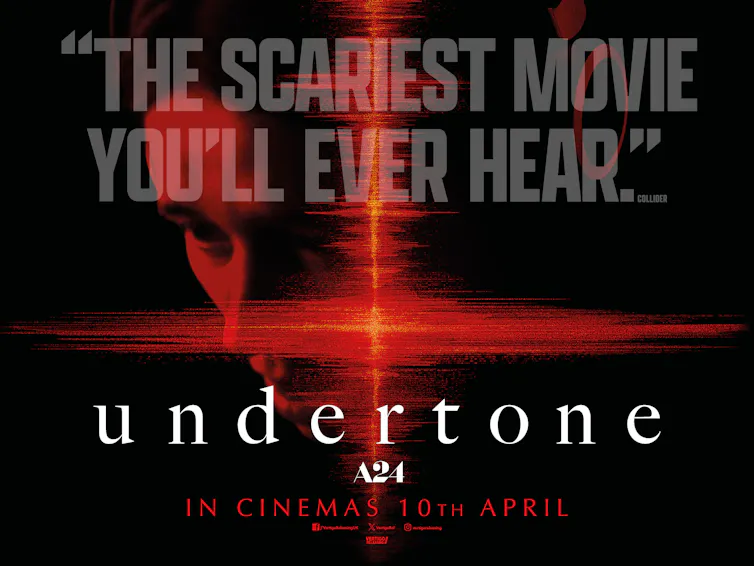
Undertone is the terrifying feature film debut from Canadian director Ian Tuason, which promises to be the “scariest movie you will ever hear”.
Evy (Nina Kiri) is a podcast host caring for her dying mother (Michèle Duquet) at home. Told only from Evy’s perspective, the film moves from initially creepy to utterly horrifying over a tense, tight 93-minute running time.
Evy’s Undertone podcast explores supernatural phenomena. Her co-host Justin (Adam DiMarco) is in another time zone, so they record online in the middle of the night, Evy’s time. This veers close to the “witching hour”, but as Evy is the podcast’s resident sceptic – the voice of reason opposing Justin’s belief in the paranormal – she is unbothered. Until she’s not.
For this week’s instalment, Evy and Justin react to a series of mysterious recordings involving a couple: Jessa (Keana Lyn Bastidas), who has begun talking in her sleep, and her husband Mike (Jeff Yung), who records her. These clips lend the story a naturally escalating structure, as the material grows increasingly distressing and the sense of dread intensifies.
As elements from the recordings seep into Evy’s world and her sense of reality begins to shift, Kiri proves superb in the role. Alone onscreen aside from her unconscious mother, she balances a raw fragility with intense emotional control. Kiri carries the film almost entirely, with supporting characters reduced to voices in her headphones or on her phone.
Undertone’s domestic setting has an uncanny familiarity to it, with soft furnishings, lamps and religious artwork bathed in cold, often unpredictably flickering light. Compounding the disquiet is the fact that Tuason used his childhood home in Toronto as his filming location, inspired by caring for his own ailing parents.
The result is an uneasy intimacy which blurs the line between personal memory and horror. This, combined with Evy’s mother’s impending death and the harrowing implications of the audio clips, makes the film a disturbing yet consistently absorbing experience.
At times, though, Tuason leans too heavily on religious iconography to generate unease, diluting some of the originality. The film also flirts with shock value using inherently distressing subject matter, rather than fully earning its impact.
Sound as terror
Sound design is Undertone’s real strength. As podcast host Justin says: “Don’t be afraid of the dark, be afraid of the silence.”
The film captures the sound of podcasting with close, warm, immaculately clear voices and achieves an intimate, studio-polished quality. Building the sense of unease, there are authentic-sounding sleep-talking recordings, nursery rhymes played backwards, exaggerated household noises such as taps and whistling kettles, and prolonged silences.
Other horror films such as Berberian Sound Studio, The Black Phone and Keeper have harnessed the unsettling potential of sound in recent years, exploring the eerie power of disembodied voices.
 Vertigo Releasing UK
This is a lineage Undertone joins while carving out a more intimate horror. Tuason’s film also makes narrative use of the podcast hosts’ editing skills to great effect, as they speed up, slow down, reverse and replay the recordings over and over, trying to glean some sense from them. In doing so, sound becomes Undertone’s primary source of terror, placing its audience in the same position as Evy.
Undertone is a confident debut from Tuason, who understands exactly where the film’s power lies. By grounding its horror in voice and sound, the film becomes an experience that feels immediate and inescapable.
In placing us so firmly within Evy’s singular perspective, Undertone crosses the boundary between listener and participant, resulting in a work which fulfils its promise of terror. It is not for the faint of heart.
- Fear
- Horror
- Podcasting
- suspense
Author
-
 Laura O'Flanagan
PhD Candidate, School of English, Dublin City University
Disclosure statement
Laura O'Flanagan does not work for, consult, own shares in or receive funding from any company or organisation that would benefit from this article, and has disclosed no relevant affiliations beyond their academic appointment.
Partners

Dublin City University provides funding as a member of The Conversation UK.
View all partners
DOI
https://doi.org/10.64628/AB.ka9xm357p
Events
Jobs
-

Research Fellow in Math Modelling of Multicellular Interfaces
-
Lecturer or Senior Lecturer, Digital Health - AI in Medicine
-
Visiting Professor - 2027 Australia-Korea Chair in Australian Studies at Seoul National University
-
Politics & Society Editor (UK Edition)




- Editorial Policies
- Community standards
- Republishing guidelines
- Analytics
- Our feeds
- Get newsletter
- Who we are
- Our charter
- Our team
- Partners and funders
- Resource for media
- Contact us
-
-
-
-
Copyright © 2010–2026, The Conversation