- Home
Edition
Africa Australia Brasil Canada Canada (français) Català España Europe France Global Indonesia New Zealand United Kingdom United States Skip to content Edition:
Global
Edition:
Global
- Africa
- Australia
- Brasil
- Canada
- Canada (français)
- Català
- España
- Europe
- France
- Indonesia
- New Zealand
- United Kingdom
- United States
Academic rigour, journalistic flair
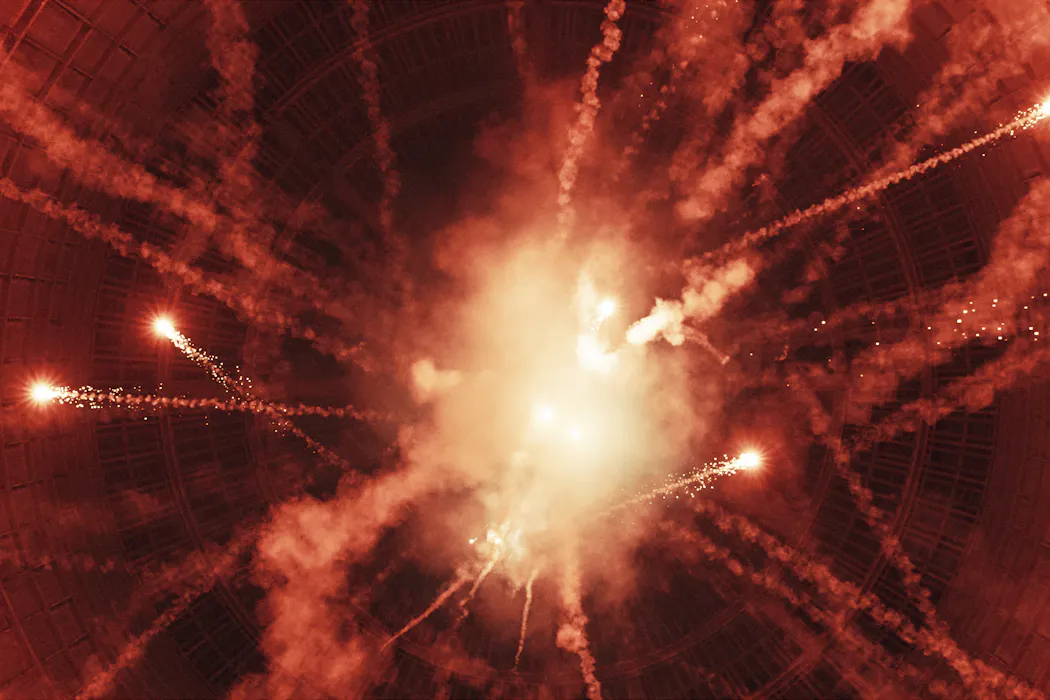
 Museum of Old and New Art/Flickr, CC BY-SA
Breathing two‑billion‑year old air: MONA’s Hard Core is an artistic journey through deep time
Published: June 9, 2026 9.10pm BST
https://theconversation.com/breathing-two-billion-year-old-air-monas-hard-core-is-an-artistic-journey-through-deep-time-284553
https://theconversation.com/breathing-two-billion-year-old-air-monas-hard-core-is-an-artistic-journey-through-deep-time-284553
Link copied
Share article
Museum of Old and New Art/Flickr, CC BY-SA
Breathing two‑billion‑year old air: MONA’s Hard Core is an artistic journey through deep time
Published: June 9, 2026 9.10pm BST
https://theconversation.com/breathing-two-billion-year-old-air-monas-hard-core-is-an-artistic-journey-through-deep-time-284553
https://theconversation.com/breathing-two-billion-year-old-air-monas-hard-core-is-an-artistic-journey-through-deep-time-284553
Link copied
Share article
Share article
Copy link Email Bluesky Facebook WhatsApp Messenger LinkedIn X (Twitter)Print article
The structure of the Museum of Old and New Art (MONA) is cut directly into Hobart’s Berriedale Peninsula – walls carved from roughly 250-million-year-old sandstone that formed when Tasmania was still part of the supercontinent Gondwana.
It’s the perfect setting for Berlin-based French-Swiss artist Julian Charrière’s latest exhibit, Hard Core. This is not just an exhibition about rocks. It is about how we humans fit into deep time, and how we dig up, reshape and use rocks that took millions of years to form.
Viewed through an earth scientist’s eyes, Charrière’s sprawling exhibition feels like an abstract field trip, moving between ancient rocks, glacial boulders, volcanic products, and the materials that underpin modern life.
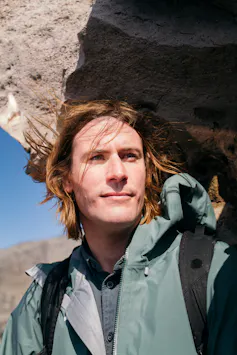 Portrait of Julian Charrière.
Museum of Old and New Art/flickr, CC BY
Portrait of Julian Charrière.
Museum of Old and New Art/flickr, CC BY
Humans as a geological force
Many of Charrière’s works explore a simple but powerful idea: the things we consume are bound to deep time. The rocks, minerals and metals underpinning modern life took thousands to millions of years to form, yet we extract them in an instant.
The first work is Not All Who Wander Are Lost (2019). It shows four glacial erratics: boulders carried by glacial ice and deposited far away from where they formed. The name derives from the latin errare, which means “to wander”.
The boulders, roughly waist to chest high, were all collected from the same Swiss valley (though each one began its journey from a different source).
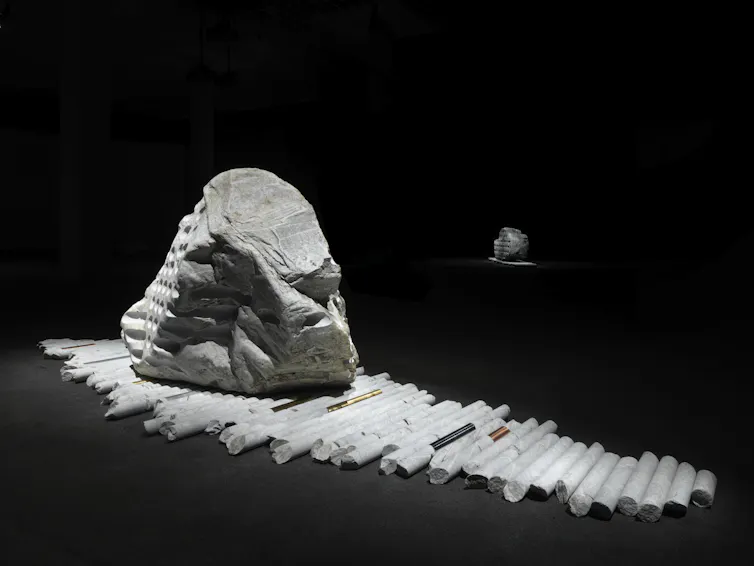 Not All Who Wander Are Lost is a 2019 work made of four ‘glacial erratics’.
Museum of Old and New Art/flickr, CC BY
Not All Who Wander Are Lost is a 2019 work made of four ‘glacial erratics’.
Museum of Old and New Art/flickr, CC BY
The erratic rocks sit atop a row of “drill cores”, long cylinders of rock usually extracted from deep underground. Like flipping through the pages of a book, scientists can study drill cores to get clues into the Earth’s history and resources.
Charrière has broken the cylinders and repaired them with metals such as brass, aluminium and stainless steel — materials that come from rocks themselves.
The contrast is uncomfortable. While geological processes moved these rocks over thousands of years, humans now shift them across the world, cut into them and remake them into modern materials.
This work isn’t simply about glaciation or mining; it’s about humanity’s growing role as a geological force.
Breathing two-billion-year-old air
Charrière’s fascination with the natural world is clearest in Breathe (2026), a permanent installation that opened with Hard Core. It draws on the ancient rocks of the Pilbara in Western Australia, home to some of the world’s largest banded iron formations.
These began forming around 2.4 billion years ago during the Great Oxidation Event, when photosynthesising microbes began releasing oxygen into Earth’s oceans and atmosphere. Without this oxygen, complex life, including humans, may have never evolved.
Charrière describes Breathe as a kind of time machine. A reactor and electrolyser (developed with scientists) releases oxygen locked in the rocks into a circular chamber visitors enter one at a time.
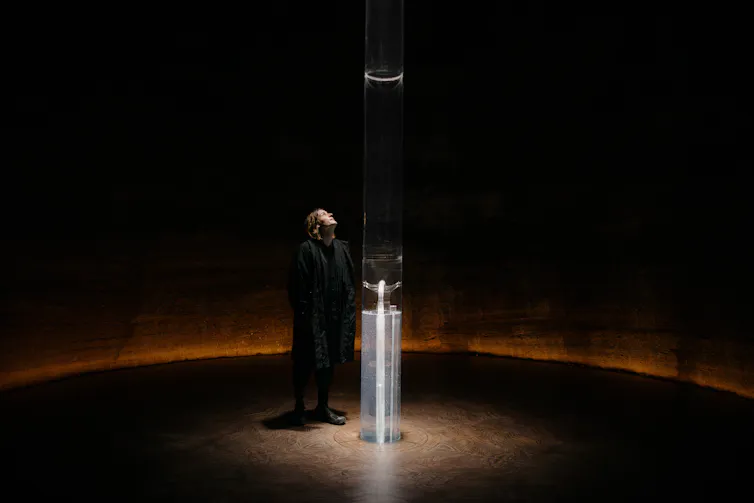 Julian Charrière beside the Hofmann apparatus in Breathe (2026), which releases oxygen extracted from ancient rocks.
Museum of Old and New Art/flickr, CC BY
Julian Charrière beside the Hofmann apparatus in Breathe (2026), which releases oxygen extracted from ancient rocks.
Museum of Old and New Art/flickr, CC BY
For a brief moment, they are the only person on Earth breathing air that has been trapped in rock for more than two billion years. Geological history usually feels remote, but Breathe removes that distance.
Inside the volcano
As a volcanologist, I was drawn to a cavernous space Charrière described as the “core” of his Hard Core exhibition. Surrounded by mirrored walls, this space rumbles, vibrates and flashes with light, creating an unsettling sensation of standing inside a volcano.
The space brings together several separate but interconnected works.
A Stone Dream of You (2024) features sculptures made from real volcanic lava bombs (lumps of molten rock flung from a volcano) and polished obsidian spheres (volcanic glass), while Thickens, pools, flows, rushes, slows (2020) is a striking sculpture made from shards of obsidian.
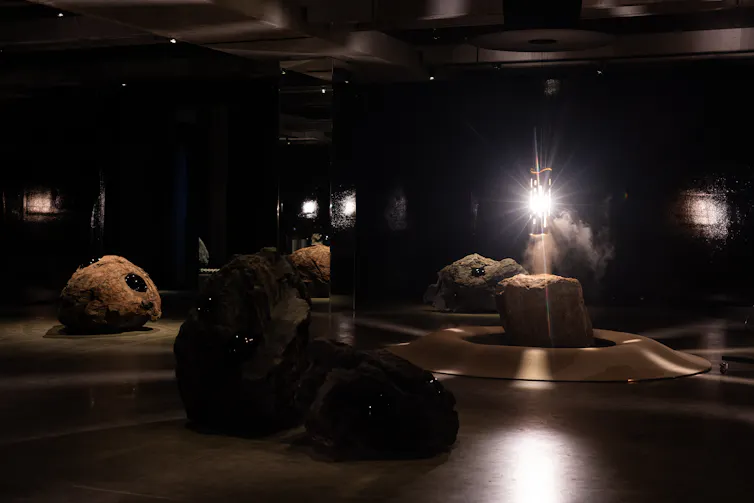 The ‘core’ of the ehxibit is a cavernous mirrored room, featuring sculptural works alongside an immersive sound installation.
Museum of Old and New Art/flickr, CC BY
The ‘core’ of the ehxibit is a cavernous mirrored room, featuring sculptural works alongside an immersive sound installation.
Museum of Old and New Art/flickr, CC BY
Both of these sit alongside Stone Speakers, a 4D sound installation playing recordings from five different active volcanoes around the world. Though distinct, the works are arranged together to create the atmosphere of a volcanic caldera.
Visitors can lie down and feel the seismic data resonating through the floor and their body — Earth’s restless pulse made physical.
A few other pieces kept me thinking after I left. In Atlas (2025), a Precambrian stromatolite is slowly polished into a sphere by rotating grinders. It was mesmerising, though I felt uneasy watching such an ancient object wear away.
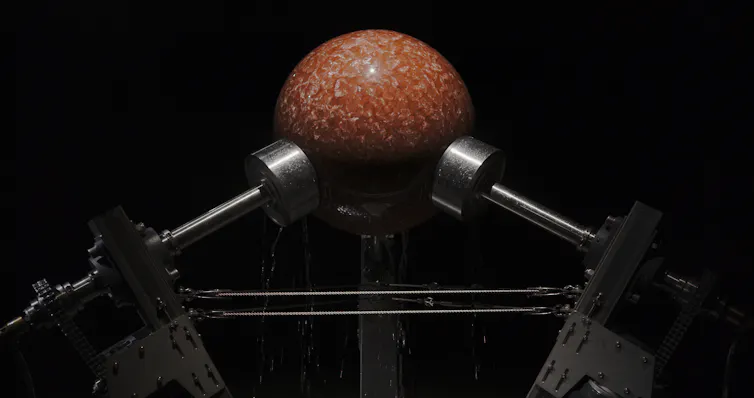 Atlas is a kinetic work in which an ancient stromatolite fossil is slowly ground into a sphere.
Museum of Old and New Art/flickr, CC BY
Atlas is a kinetic work in which an ancient stromatolite fossil is slowly ground into a sphere.
Museum of Old and New Art/flickr, CC BY
Another work, Soothsayer (2021), is a large lump of coal held at eye level, in a steel scaffold, with a cavity that’s big enough for a human head. Visitors are invited to stick their head in and breathe the air.
This piece flips the idea of burying your head in the sand. It asks you to sit for a moment with the coal’s deep past, and the fossilised life it’s made from.
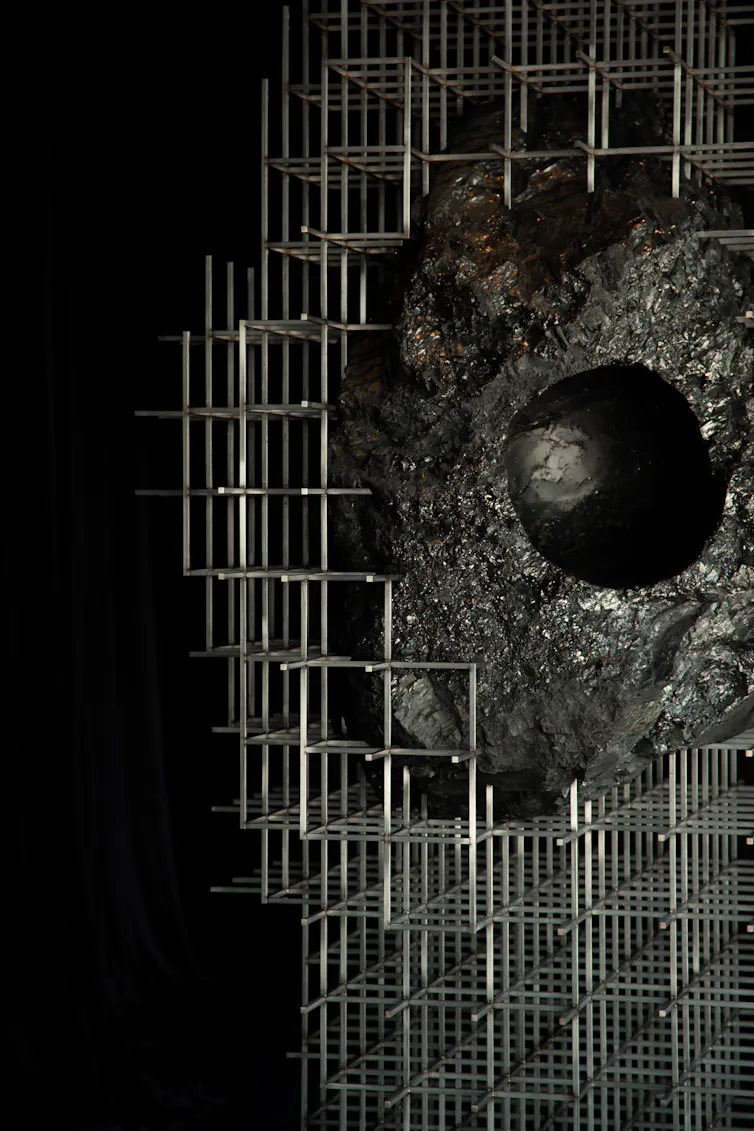 In Soothsayer, visitors can stick their head into a large, hollowed out piece of coal.
Museum of Old and New Art/flickr, CC BY
In Soothsayer, visitors can stick their head into a large, hollowed out piece of coal.
Museum of Old and New Art/flickr, CC BY
Rocks as storytellers
Hard Core reminded me why I became a geologist. I love telling the stories of the extraordinary journeys rocks have been on – fragments of Earth’s deep history preserved beneath our feet.
Charrière goes one step further with this exhibition. His work highlights how humans are now part of those stories. We aren’t separate from the geological world, but are actively reshaping it.
Charrière invites us to see rocks differently: not as scenery, resources, or museum objects, but as storytellers carrying the history of the planet, and increasingly, our own.
Hard Core is showing at MONA until March 29, 2027.
- Earth science
- Geology
- Volcanoes
- Art
- MONA
- Visual art
- Art Galleries
- Deep time
- Environmental Art
- art exhibits
Author
-
 Hannah Moore
University Associate, Earth Sciences, University of Tasmania
Disclosure statement
Hannah Moore is affiliated with not-for-profit organisation, Australian Earth Science Education.
Partners

University of Tasmania provides funding as a member of The Conversation AU.
View all partners
DOI
https://doi.org/10.64628/AA.j5hrwhath
Events
Jobs
-

Senior Clinical Research Scientist (Neurophysiologist)
-
Deputy Editor, Arts and Culture
-
Forensicare Postdoctoral Research Fellow/Research Fellow
-
Police Cadet, South Australia Police



- Editorial Policies
- Community standards
- Republishing guidelines
- Analytics
- Our feeds
- Get newsletter
- Who we are
- Our charter
- Our team
- Partners and funders
- Resource for media
- Contact us
-
-
-
-
Copyright © 2010–2026, The Conversation