
- Home
Edition
Africa Australia Brasil Canada Canada (français) Català España Europe France Global Indonesia New Zealand United Kingdom United States Skip to content Edition:
Global
Edition:
Global
- Africa
- Australia
- Brasil
- Canada
- Canada (français)
- Català
- España
- Europe
- France
- Indonesia
- New Zealand
- United Kingdom
- United States
Academic rigour, journalistic flair
 Forests everywhere are critical to climate stability, biodiversity conservation and sustainable livelihoods, yet they remain in decline due to a variety of pressures.
(Unsplash/Viacheaslav Marushchenko)
Greater international co‑operation is needed to achieve the UN’s global forest goals
Published: June 9, 2026 8.45pm BST
https://theconversation.com/greater-international-co-operation-is-needed-to-achieve-the-uns-global-forest-goals-283656
https://theconversation.com/greater-international-co-operation-is-needed-to-achieve-the-uns-global-forest-goals-283656
Link copied
Share article
Forests everywhere are critical to climate stability, biodiversity conservation and sustainable livelihoods, yet they remain in decline due to a variety of pressures.
(Unsplash/Viacheaslav Marushchenko)
Greater international co‑operation is needed to achieve the UN’s global forest goals
Published: June 9, 2026 8.45pm BST
https://theconversation.com/greater-international-co-operation-is-needed-to-achieve-the-uns-global-forest-goals-283656
https://theconversation.com/greater-international-co-operation-is-needed-to-achieve-the-uns-global-forest-goals-283656
Link copied
Share article
Share article
Copy link Email Bluesky Facebook WhatsApp Messenger LinkedIn X (Twitter)Print article
While many people tacitly appreciate the intrinsic and aesthetic value forests and trees provide, governments and policymakers have struggled to take firm action to protect the Earth’s forests.
The Global Forest Goals Report 2026, to which we contributed, was released at the recent United Nations Forum on Forests in New York. It represents an urgent call to action.
The report takes stock of progress made towards meeting the six Global Forest Goals and 26 associated targets of the UN Strategic Plan for Forests, emphasizing the importance of forests in meeting the 2030 Agenda for Sustainable Development. Compiled from voluntary reports contributed by 48 nations representing more than half of all global forests, it provides an invaluable overview of how they are managed.
While some progress has been made since these goals were established in 2017, it is uneven. Only seven of the 26 targets have been broadly met, 17 are only partly met and two — reversing deforestation and eradicating extreme poverty for forest-dependent people — are completely off track.
Between 2015 and 2025, the world lost more than 40 million hectares of forest, an area slightly larger than Germany or Japan, including 16 million hectares of primary forests, which are of particular importance for biodiversity and the climate.
Pressures from expanding road networks, forest degradation and land-use changes continue to threaten forests in many regions, through both state-sanctioned and illegal activities.
International co-operation
 Bluebells, also known as wild hyacinth, bloom in Hallerbos forest south of Brussels, Belgium.
(AP Photo/Virginia Mayo)
Bluebells, also known as wild hyacinth, bloom in Hallerbos forest south of Brussels, Belgium.
(AP Photo/Virginia Mayo)
Gains have been made in terms of protected areas, expansion of long-term forest management plans and forest-related monitoring systems. The report contains many success stories and signs of hope. There are several mentions of national programs and international co-operation that have resulted in real, tangible benefits for forests and the people who depend on them for their livelihoods.
Canada is among those acknowledged. The country’s 2024 Wildland Fire Prevention and Mitigation Strategy takes a “whole-of-society” approach to wildland fire resilience. It aims to deepen partnerships with Indigenous Peoples, expand knowledge and understanding of wildfire risk, and scale up investments in prevention and mitigation — all toward building greater resilience of communities and infrastructure across Canada by 2030.
However, climate change is bringing warmer weather, lowering water tables and reducing moisture. Risks are also growing due to an increasing number of fire-igniting lightning strikes.
Projections indicate that the fire season in Canada, along with much of the world’s temperate regions, will begin sooner and last longer each year. Wildfires are also increasingly occurring where wildlands meet human development, posing a greater threat to critical infrastructure, communities and industrial activities.
These financial and environmental concerns are not isolated to Canada’s 370 million hectares of forests, which make up nine per cent of the world’s total forest area, but extend worldwide. Forests everywhere are critical to climate stability, biodiversity conservation and sustainable livelihoods, yet they remain in decline due to a wide variety of pressures.
While in the past forests were seen as a purely domestic issue, international co-operation and action is necessary to address a suite of forest-related challenges that stretch beyond borders.
Protecting forests
Individual country reports also indicate that forests are increasingly recognized not only for their ecological functions but also as a foundation for rural development and poverty alleviation.
Forests underpin nearly every goal the world has set for sustainable development by 2030, from ending poverty and hunger to securing clean water, clean energy and decent livelihoods for well over a billion people. Yet many countries report that the full realization of the economic and social benefits of forests remains constrained by weak market access and limited economic opportunities.
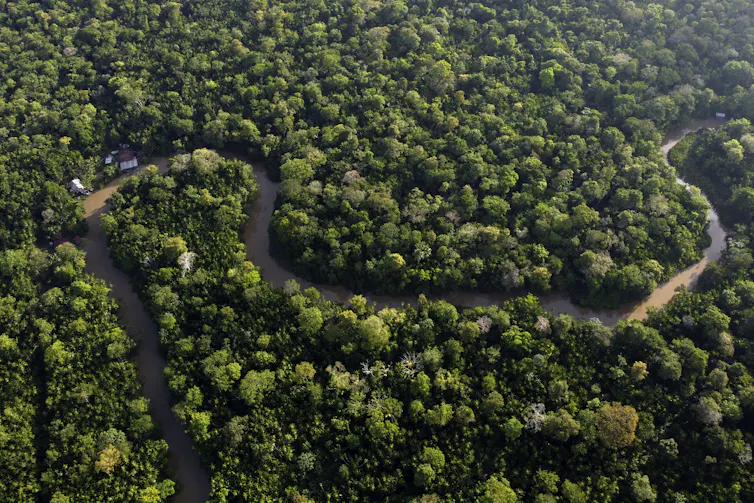 A part of the Amazon Rainforest on Combu Island near the city of Belem, Brazil.
(AP Photo/Eraldo Peres)
A part of the Amazon Rainforest on Combu Island near the city of Belem, Brazil.
(AP Photo/Eraldo Peres)
We have never been more in need of collective action on global environmental challenges, yet current geopolitical tensions and the prioritization of near-term national interests place international co-operation at risk. Development assistance, including support for multilateral institutions, declined by 23 per cent from 2024 to 2025 — the largest annual contraction on record.
Meanwhile, private financial institutions provided US$8.9 trillion in financing to companies with the highest deforestation risk. Environmentally harmful agricultural subsidies reached approximately US$406 billion annually, compared to a total of just US$84 billion in finance flows to protect forests.
The report makes clear that the tools, knowledge and the policy frameworks exist. Innovative financing, stronger institutions and cross-sectoral co-operation are essential to meet the goals.
National leadership and community-driven solutions demonstrate that progress can be accelerated when ambition is matched by action. It is time to think about how to increase the political will towards international co-operation on climate and forests, and the financial commitment to back it.
- Conservation
- Forests
- Biodiversity
- Forest conservation
- Wildfires
- United Nations
Authors
-
 Terry Sunderland
Professor in the Faculty of Forestry, University of British Columbia
-
Peter Wood
Lecturer, Faculty of Forestry and Environmental Stewardship, University of British Columbia
Disclosure statement
The authors do not work for, consult, own shares in or receive funding from any company or organisation that would benefit from this article, and have disclosed no relevant affiliations beyond their academic appointment.
Partners

University of British Columbia provides funding as a founding partner of The Conversation CA.
University of British Columbia provides funding as a member of The Conversation CA-FR.
View all partners
DOI
https://doi.org/10.64628/AAM.u76njcfcc
Events
Jobs
-

Senior Clinical Research Scientist (Neurophysiologist)
-
Deputy Editor, Arts and Culture
-
Forensicare Postdoctoral Research Fellow/Research Fellow
-
Police Cadet, South Australia Police




- Editorial Policies
- Community standards
- Republishing guidelines
- Analytics
- Our feeds
- Get newsletter
- Who we are
- Our charter
- Our team
- Partners and funders
- Resource for media
- Contact us
-
-
-
-
Copyright © 2010–2026, The Conversation