- Home
Edition
Africa Australia Brasil Canada Canada (français) Català España Europe France Global Indonesia New Zealand United Kingdom United States Skip to content Edition:
Global
Edition:
Global
- Africa
- Australia
- Brasil
- Canada
- Canada (français)
- Català
- España
- Europe
- France
- Indonesia
- New Zealand
- United Kingdom
- United States
Academic rigour, journalistic flair
 Dave Colman/Shutterstock
Left‑of‑centre parties like Labour face challenges from both right and left – here’s what they can do about it
Published: June 9, 2026 4.09pm BST
https://theconversation.com/left-of-centre-parties-like-labour-face-challenges-from-both-right-and-left-heres-what-they-can-do-about-it-284774
https://theconversation.com/left-of-centre-parties-like-labour-face-challenges-from-both-right-and-left-heres-what-they-can-do-about-it-284774
Link copied
Share article
Dave Colman/Shutterstock
Left‑of‑centre parties like Labour face challenges from both right and left – here’s what they can do about it
Published: June 9, 2026 4.09pm BST
https://theconversation.com/left-of-centre-parties-like-labour-face-challenges-from-both-right-and-left-heres-what-they-can-do-about-it-284774
https://theconversation.com/left-of-centre-parties-like-labour-face-challenges-from-both-right-and-left-heres-what-they-can-do-about-it-284774
Link copied
Share article
Share article
Copy link Email Bluesky Facebook WhatsApp Messenger LinkedIn X (Twitter)Print article
These are tough times for social democratic parties. Defined by their support for a strong welfare state within a capitalist economy, these parties have seen their traditional voter bases erode in recent years. And in government, they appear to many to have abandoned any last signs of a radical reformist outlook. It has even led some to speculate that the social democratic era may be over.
There remains a large variation in the electoral success of social democratic parties. The dismal performance of the French Socialist party recently stands in contrast to the more successful trajectory of progressive parties in Australia and Spain.
In the UK, Labour won a landslide in the 2024 general election, albeit one that was magnified by the British electoral system. But since then, it has suffered a collapse in devolved elections and in local polls.
Read more: From landslide to leadership crisis: where did it all go wrong for Keir Starmer?
In our book, Practical Social Democracy, we suggest that a new approach to social democracy is needed. As a political movement, social democratic reformism is often understood as an abstract construct – for example, a model based around high public spending and high taxation in a “mixed economy”. At other times it is seen more as an ideology to be followed. Both of these perspectives can be inflexible.
We emphasise the practical nature of social democracy – activities that are shaped by the context within which governments find themselves. This includes the policy legacies they inherit (the state of the economy, for example) and the political norms that guide decision-making.
Of course there are competing demands on political parties. They need to govern across diverse policy areas with whatever resources they can generate. In a democracy, they also need to win office, often either building coalitions of voters or developing alliances with other parties. They need an activist base (and in the case of social democratic organisations some sort of link to trade unions). And they need to pay for the things they want to do.
‘What matters is what works’
In governing, social democratic parties must be able to react to their circumstances, to learn, adapt and evolve. In other words, governing is messy and involves compromise, adjustment and trade-offs.
In the UK’s case, the consequences of focusing on practical social democracy are clear. The Labour party has resisted adopting long-term goals that might define what a socialist society should look like. Instead it has concentrated on immediate results: “What matters,” former Labour prime minister Tony Blair used to say, “is what works.”
Labour’s current programme is shaped by the legacies of the previous Conservative government, including tax cuts and the emerging discourse about tax burdens (for example, the feasibility of continuing the “triple lock” that sees state pensions increase by inflation, average wage rises or 2.5% – whichever is highest).
The practical character of Keir Starmer’s party is manifest in its electoral prospects. Labour now faces multiple challenges: from Reform UK on the right; from Green voters committed to environmental readjustment; and from Liberal Democrats tracking a moderate model of the welfare state.
Some of Labour’s policy choices – restricting winter fuel payments most obviously – have angered the party’s membership and its affiliated trade unions. Welding these electoral and political demands into a single position can result in instability.
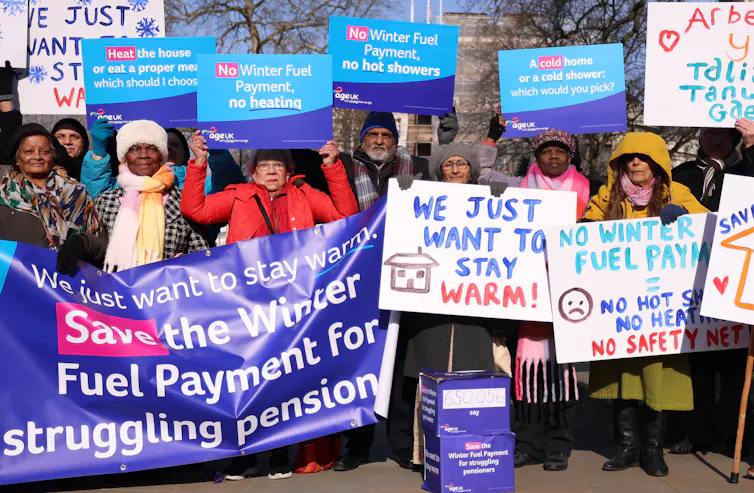 London pensioners protested cuts to the winter fuel payment last year.
Andy Rain/EPA
London pensioners protested cuts to the winter fuel payment last year.
Andy Rain/EPA
In contrast, in the 1960s the Swedish Social Democrats began implementing an ideologically driven welfare state. However, in spite of its popularity with voters, the economic foundations started to wobble in the 1970s amid criticism of the high taxes needed to sustain the project.
The party leadership was forced to adjust taxes. But it struggled to reduce the tax burden for those on lower wages without cutting it for those on higher salaries too. This triggered outcry from key activist groups such as influential trade unions. It also limited how far the welfare state could go.
The party’s key ideological project lost steam from the 1990s. Whether there may have been an alternative route is difficult to tell, but the practical nature of handling conflicting demands is key to understanding why the party lost both its ideological thread and its voters.
But focusing on practical social democracy is not an excuse to grow complacent. It challenges neither the electoral difficulties nor the economic constraints that some progressive parties have struggled with. Clearly the social democratic prospect is under pressure.
Looking at the different practices of social democratic parties, however, provides insights into the nature of reformism – and of the potential difficulties and opportunities. Social democracy, we suggest, is at its heart a practical phenomenon rather than an ideological one. Its ability to negotiate the challenges in its path will have important consequences for the movement’s ultimate success or failure.
- UK politics
- Sweden
- Labour Party
- Welfare state
- social democracy
Authors
-
 Mark Wickham-Jones
Emeritus Professor of Political Science, University of Bristol
-
Jonas Hinnfors
Professor Emeritus of Political Science, University of Gothenburg
-
Magnus Feldmann
Associate Professor, School of Sociology, Politics and International Studies, University of Bristol
Disclosure statement
Mark Wickham-Jones is a member of the Labour Party: he has attended most Labour Party annual conferences since 1988; he has attended two local party meetings since 1988.
Jonas Hinnfors and Magnus Feldmann do not work for, consult, own shares in or receive funding from any company or organisation that would benefit from this article, and have disclosed no relevant affiliations beyond their academic appointment.
Partners

University of Bristol provides funding as a founding partner of The Conversation UK.
View all partners
DOI
https://doi.org/10.64628/AB.5cw64r76x
Events
Jobs
-

Senior Clinical Research Scientist (Neurophysiologist)
-
Deputy Editor, Arts and Culture
-
Forensicare Postdoctoral Research Fellow/Research Fellow
-
Police Cadet, South Australia Police




- Editorial Policies
- Community standards
- Republishing guidelines
- Analytics
- Our feeds
- Get newsletter
- Who we are
- Our charter
- Our team
- Partners and funders
- Resource for media
- Contact us
-
-
-
-
Copyright © 2010–2026, The Conversation