 Karis48/Getty Images
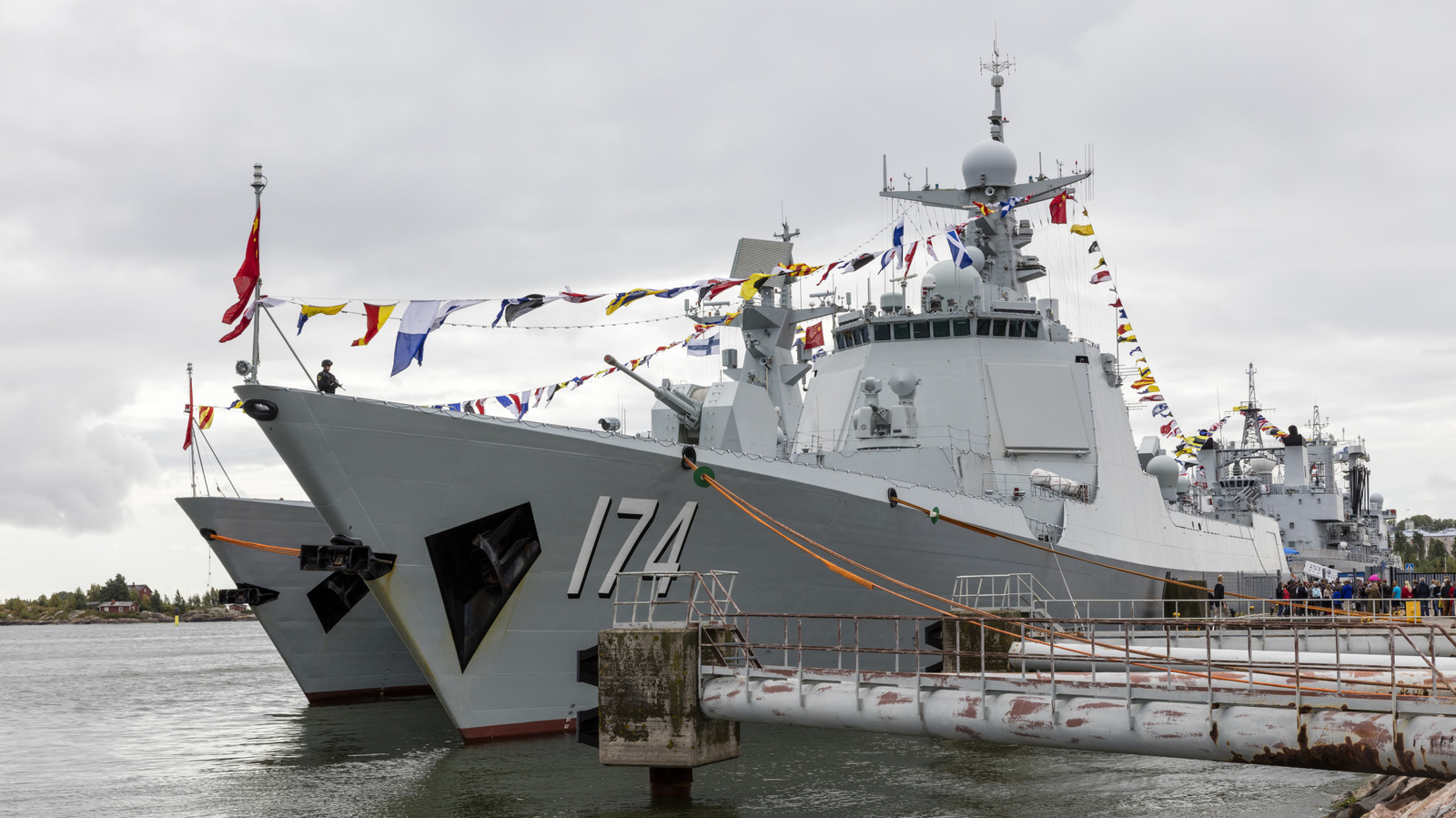
For nearly a century, the United States Navy has maintained a significant technological and capability edge over nearly every other naval force on Earth. However, there is no denying that there has been growing concern among U.S. military analysts about China's emergence as a naval and military power. For decades now, China has been ramping up its pace of building new naval ships, while also upgrading its capabilities. Today, its navy is considered among the world's biggest, and at the current pace of production, China's fleet of destroyers could outnumber that of the U.S in the coming years.
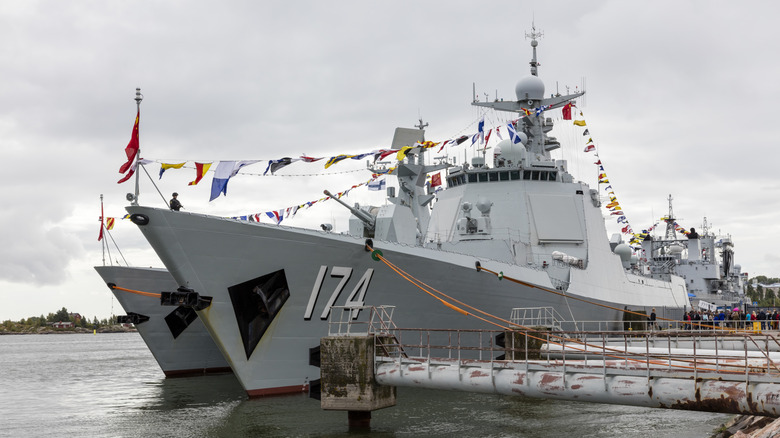
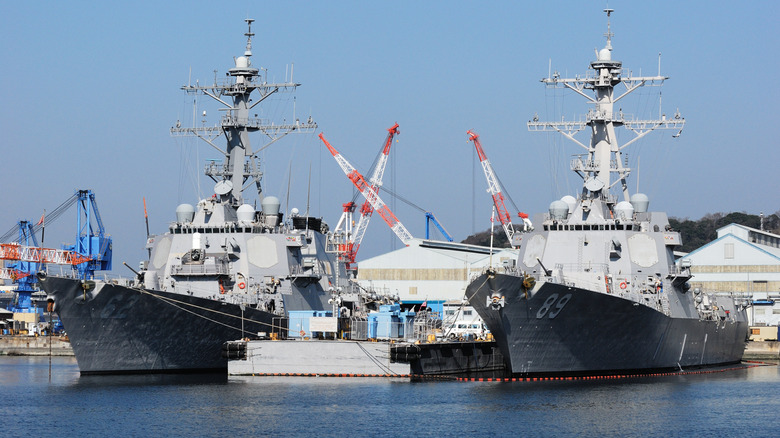
A large part of China's modernization drive has centered around two classes of warships: the Type 052D destroyer and the larger Type 055 destroyer. The sheer pace at which China has been building these vessels has garnered global attention. Publicly available data indicate that over the last 10 years, China has built a total of 35 Type 052D destroyers and 8 Type 055 destroyers, bringing the total number of destroyers in its fleet to 43. In comparison, the same time frame witnessed the U.S. Navy add only around 18-20 equivalent vessels, the Arleigh Burke-class destroyers, to its fleet. If China maintains the same production rate, the country is on track to overtake the U.S. in having the largest fleet of destroyers.
In terms of overall fleet size, the Chinese Navy is already ahead of the U.S. The country currently operates the world's largest maritime force with 234 warships in its fleet compared to the U.S. fleet of 219. China is also on track to widen the gap substantially over the next several years, with plans to deploy as many as 425 vessels by 2030.
Why production capacity matters
 viper-zero/Shutterstock
A long-held notion among U.S. military planners was that Chinese destroyers (and military equipment in general) are not individually superior to an equivalent American vessel. However, China's ability to build a large number of vessels nullifies this advantage by virtue of sheer numbers. There is historical evidence supporting the notion that countries with larger fleets have won the vast majority of wars. The sheer number of vessels in its arsenal will allow China to absorb more losses than its rivals and let it keep fighting. This has been demonstrated in recent war games, where even after losing over 50 warships (compared with between 7 and 20 U.S. losses), China still had more warships to continue fighting.
China's military shipbuilding capability is also closely linked to the country's commercial shipbuilding industry, which, as of 2026, is the world's largest. China's largest shipbuilding company — CSSC — dabbles in the manufacturing of both commercial and naval ships, with many of its shipyards engaging in the production of both types of vessels side by side.
Some Chinese shipyards also have loose ties to the Chinese military, while several smaller ones operate as though they have no connection to it. The Chinese shipbuilding industry — by design — lacks transparency, making it difficult for analysts to assess its true capabilities and security implications in the U.S. context.
Where the U.S. still remains dominant
 Stocktrek Images/Getty Images
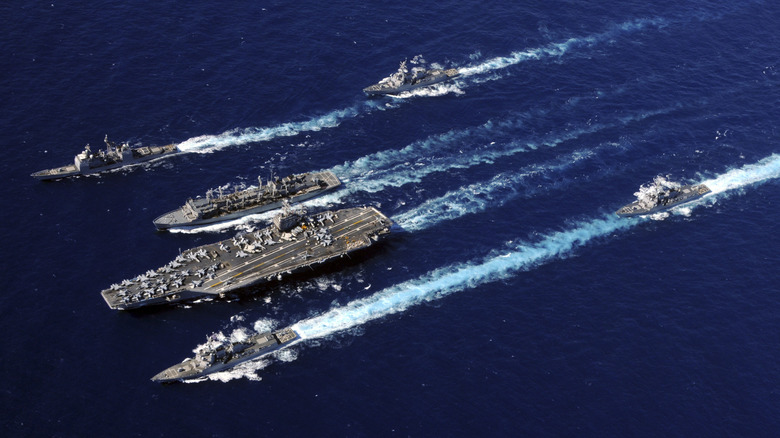
While the rise of China as a major naval power and the resulting threat to the U.S. military's dominance are undeniable, the United States continues to retain crucial advantages. The U.S. Navy has extensive combat experience, possesses a global network of naval bases, and has a large fleet of nuclear-powered submarines. The carrier aviation capabilities of the U.S. remain unmatched to this day.
Air power is another area where the U.S. continues to hold a significant edge over China. The U.S. is in possession of a large fleet of 5th-generation fighters, including the likes of the F-35 (widely believed to be the world's most advanced stealth fighter) and the ultra-stealthy F-22 Raptor. The U.S. also possesses stealth bombers like the B-2 Spirit, as well as the even more advanced, under-development B-21 bomber, which is undergoing final testing before deployment. China's own stealth fighter — the Chengdu J-20 — is relatively new and not yet battle-tested; its stealth bomber is still years away from deployment, and its true capabilities remain suspect. The country's other fighter jets are not widely known for their groundbreaking capabilities, although some claims were made about them during the Indo-Pakistani conflict in 2025.
In simpler terms, while China is taking giant strides as it evolves into a major naval and military power, the sheer technological dominance of the U.S., combined with its long history of hardened battle experience, cannot be completely ignored.